Digitalizzazione Capri
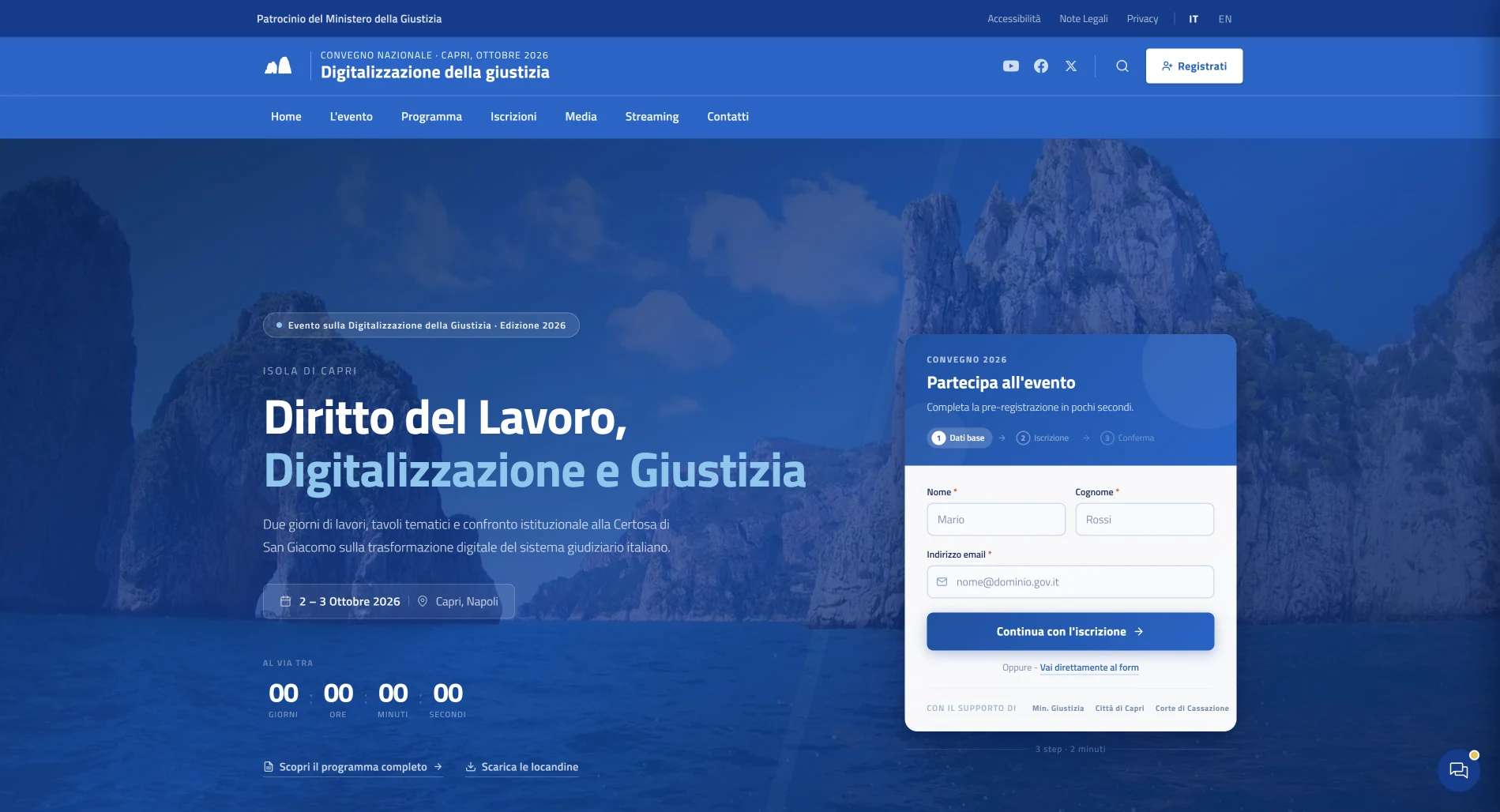
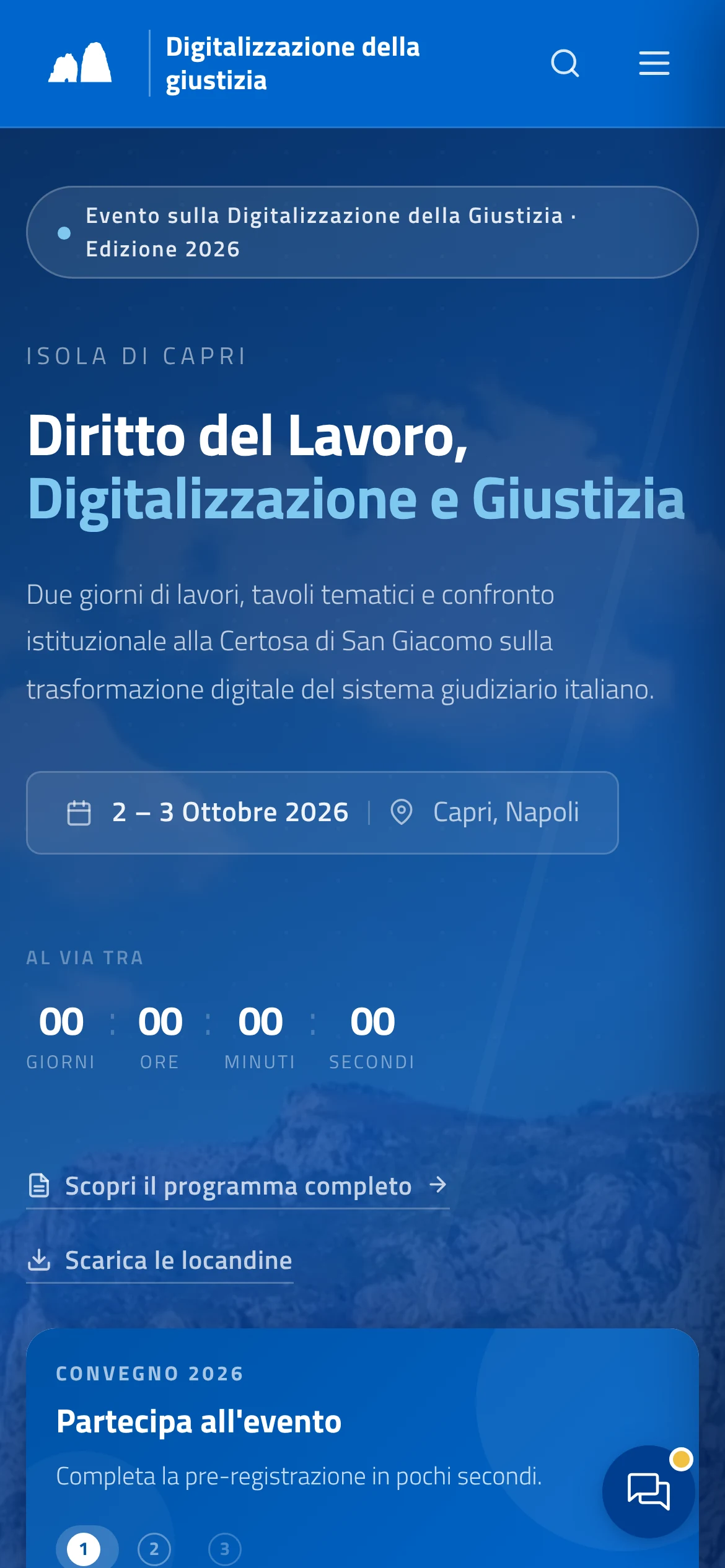
Official website of the national conference on the Digitalisation of Justice in Capri, promoted by the CED of the Supreme Court of Cassation: registration, programme, streaming and a materials archive, designed and built by me.
Fact sheet
- Role
- Complete design and development, as a volunteer
- Year
- 2023
- Status
- Public
- Sector
- Events and legal innovation
- Devices
- Web browser, Smartphone
- Main stack
- Next.js · React · TypeScript · Tailwind CSS · next-intl · Node.js · Firestore · Google Sheets API · Nodemailer · Vercel · Vitest · Accessibility · SEO
Overview
The project at a glance
Official website of the national conference on the Digitalisation of Justice in Capri, promoted by the CED of the Supreme Court of Cassation: registration, programme, streaming and a materials archive, designed and built by me.
The conference began in 2013 and is promoted by the CED of the Supreme Court of Cassation, in collaboration with the Ministry of Justice's Department for Technological Innovation and under the Ministry's patronage. Since 2023 I have digitalised its presence: I designed and built the website entirely, as a volunteer and free of charge, as a scientific contribution to the conference. I also take part in the meetings that define the scientific programme and organise the social dinners, I manage the event's mailbox and I created the graphic posters with Canva.
Features
A site for the whole life of the event
From registration to the live stream, and the archive after the conference: the site supports attendees before, during and after.
Three-step registration
Basic details, registration and confirmation. The name and email typed on the home page arrive pre-filled in the full form, where people pick time slots, working groups, social dinners and companions, and can suggest a topic or a contribution.
Programme by day
Plenary sessions, round tables and parallel workshops (civil, criminal, tax, artificial intelligence, international cooperation), with speakers, rooms and cultural activities.
Live streaming
A dedicated page shows whether the event is on air, points to the parallel sessions, and is open to everyone without registration.
Archive since 2013
Videos, materials, presentations, posters and press releases from every edition, filterable by category and edition.
News and newsletter
Articles published by the organisers, with search and category filters, and a newsletter sign-up with a privacy notice.
Site search
One search for articles, sessions and speakers, reachable from every page.
Information assistant
An assistant with guided questions and answers written and checked by the organisers.
Italian and English
All content in two languages, with directions for reaching Capri and the event venues.
The challenge
The problem to solve
Before 2023, people registered for the conference with a Microsoft Forms form, with no automatic feedback and no other digital tools supporting the event.
From a registration with no feedback to a complete digital experience.
History
From 2013 to today
The event began in 2013 on the initiative of the CED of the Supreme Court of Cassation. The website is the digital side I have been building around it since 2023, edition after edition.
2013
The first edition
The conference starts on the initiative of the CED, the Electronic Documentation Centre of the Supreme Court of Cassation.
Until 2022
Registration with Microsoft Forms
People registered with an online form, with no automatic feedback for whoever filled it in.
2023
The first website
A single page built with Elementor, with a small AI chatbot that answered by reading the site's HTML.
2024
The Next.js site
The move from Elementor to a site written in code with Next.js.
2025
A new version
A new version of the site. In October the first accessibility statement is published.
2026
The 2–3 October edition
A complete rewrite starting from the previous site. The AI chatbot gives way to an assistant with guided questions, because for the way it was used it served no purpose. Three-step registration with an automatic confirmation email and storage in Google Sheets, a programme with parallel sessions, streaming and an archive. Over 350 registrants across attendees, speakers, companions and authorities.
Approach
From problem to release
Analysis
I take part in the meetings that define the scientific programme and organise the social dinners, and I manage the event's mailbox: I know the needs of organisers and attendees first-hand.
Design
A readable, institutional interface, in Italian and English, with three-step registration and accessibility considered from the design stage.
Development
2023: a one-page site with Elementor and a small informational chatbot with AI, a small RAG that read the site's HTML. 2024: a Next.js site. 2025: a new version. 2026: a complete rewrite, derived from the previous one. Today's chatbot is a guided assistant without AI: for its use, AI was not needed.
Release
Published on Vercel, with a domain bought on Vercel. WCAG audits with axe DevTools and Accessibility Checker and code fixes, indexing with Google Search Console, automated tests on the registration form.
Architecture
How it is built
The site is a bilingual Next.js application. Registrations go through an application service that validates the data, limits requests and cleans values before writing them to a Google Sheet, then sends a confirmation email automatically. Articles and news live in Firestore. Cookie consent blocks third-party content, such as YouTube and Maps, until it is given.
Illustrative diagram
Parts of the diagram
Hover over a part, or select it, to read what it does.
Quality
Accessibility, security and privacy
An institutional site must be usable by everyone and careful with data. Here is what is in the code, and where the limits are declared.
Accessibility (WCAG 2.1 AA)
- Full keyboard navigation, with visible focus that is managed inside dialogs.
- Skip link, ARIA landmarks and a correct heading hierarchy.
- Alternative text for informative images and AA-level colour contrast.
- Respect for the reduced-motion preference and a declared language in Italian and English.
- Forms that tell assistive technologies about required fields, errors and groups of choices.
Registration security
- Client- and server-side validation, with maximum lengths and control characters removed.
- A per-IP request limit (5 a minute) and a temporary form lock after too many attempts.
- A honeypot field against bots, and sanitising values before they reach the sheet, against formula injection.
- Google and mail credentials only in environment variables, never in the code.
- 19 automated Vitest tests on the registration API.
Privacy and cookies
- A banner with granular choice: technical cookies are always on, third-party ones only with consent.
- YouTube and Google Maps stay blocked until consent is given; the choice expires after 180 days.
- Privacy notice, cookie policy and legal notes published on the site.
Visibility and SEO
- Pages rendered on the server with Next.js, with per-page and per-language metadata.
- Sitemap and robots.
- Indexing and search performance monitored with Google Search Console.
The site's accessibility statement says «partially conforming»: video captions are still in progress and the background video is declared as decorative. I state this openly on the site's Accessibility page.
Results
What changed
350+
Attendance
Registrations, including attendees, speakers, companions and authorities.
3 steps
Registration
From a registration with no feedback to a guided flow, logged in a sheet and confirmed with an automatic email.
7.9K
Visibility
Google impressions from 11 August to 9 November 2026, with 1.46K clicks and an average position of 5.8; the peak fell on the days of the conference. Most clicks come from searches for the event's name.
Data available on request
Contribution
More than code
I worked on the conference as a volunteer, free of charge, as a scientific contribution to an occasion that matters a great deal for digital justice.
Design and development of the site
Interface, frontend, backend, deployment on Vercel and the domain: the whole site.
Scientific definition of the programme
I take part in the meetings where the conference programme is defined.
Social dinners
I take part in organising the social dinners; the site collects the sign-ups.
Event email
Full management of the event's email inbox.
SEO and visibility
Indexing and monitoring with Google Search Console.
Posters
The event's graphic posters, made with Canva.
Stack
Technologies
- Frontend
- Next.js
- React
- TypeScript
- Tailwind CSS
- next-intl
- Backend
- Node.js
- Nodemailer
- Data
- Firestore
- Google Sheets API
- Infrastructure
- Vercel
- Vitest
- Fields
- Accessibility
- SEO
Gallery
Screens
More projects
Keep exploring
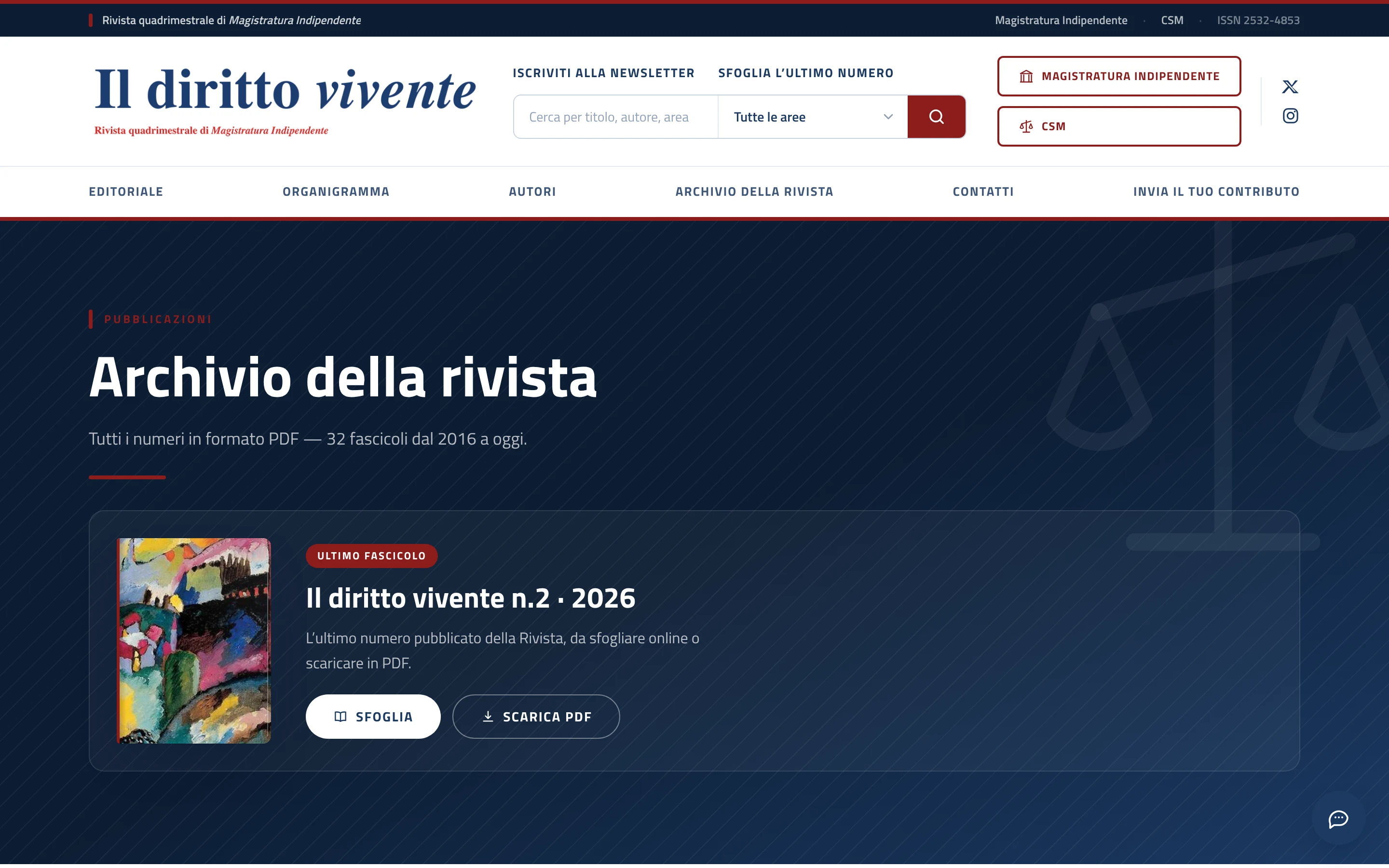
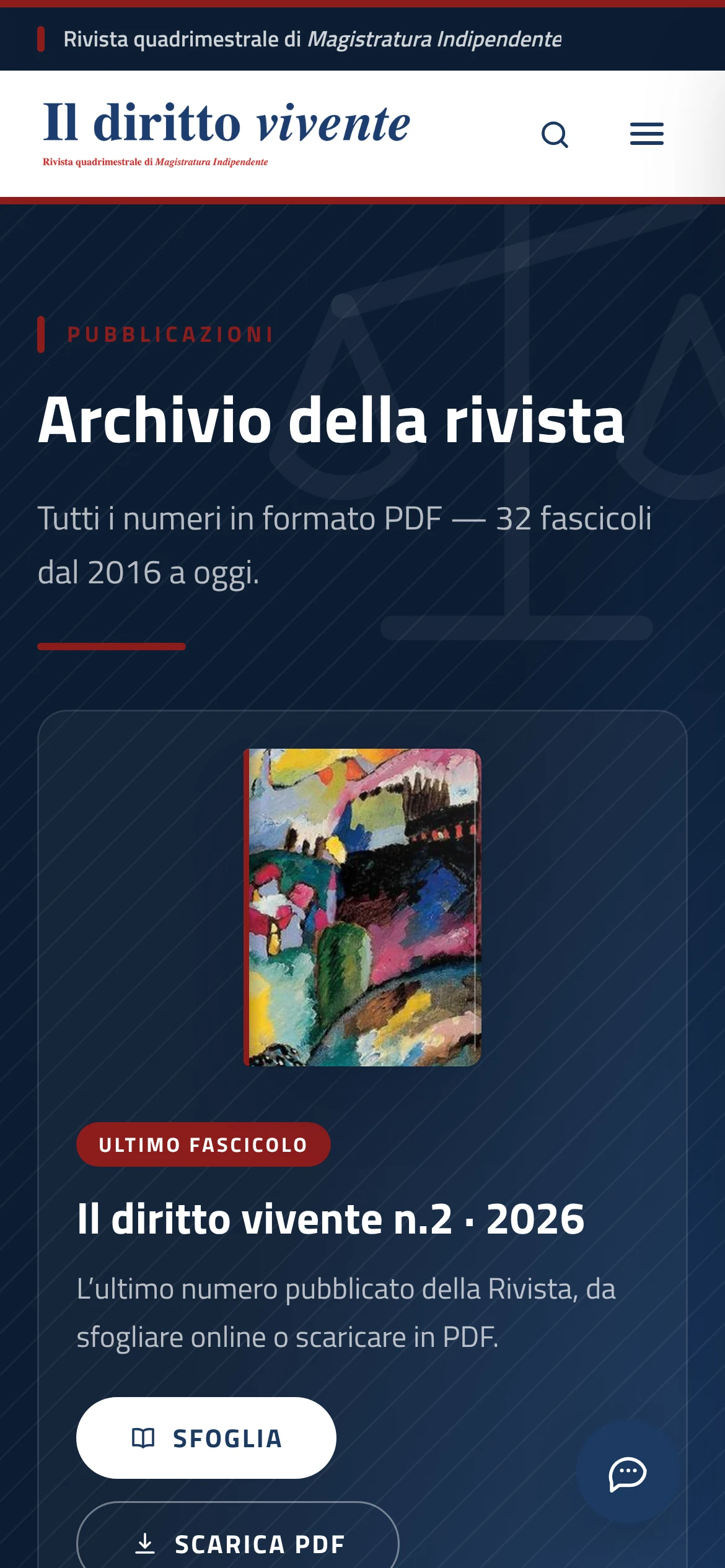
Related projects
Interested in a similar project?
Write to me: I can present the work in detail, within the limits of the confidentiality agreements.